Buyer's guide
The best D&D note-taking apps in 2026
Eight tools that GMs actually use to keep a campaign straight, what each one is genuinely good at, what it costs in September 2026, and which of them will write anything down without you.
Published by RollSummary. Meet Julio Cesar, the developer.
Every one of these tools is somebody's favourite, and most of the roundups you will find rank them as if they were competing at the same job. They are not. Three of them are worldbuilding platforms, two are general-purpose note apps, one is a session log inside a virtual tabletop, and two turn a recording of your game into notes. Picking well starts with admitting which of those problems you have.
We make one of the eight, so read this with the appropriate squint. What we have tried to do instead of pretending to be neutral is be checkable: every price below was read from the vendor's own pricing page in September 2026, every feature claim came from their documentation rather than a review site, and where a tool beats us we say which one and why. Where we could not confirm something, we say that too.
One more thing worth setting up front, because it decides most of this list. A tool that requires you to type is only as good as your discipline at 1am after a four hour session. A tool that writes for you is only as good as its judgement, and judgement is where these things fail in embarrassing ways. That trade is the actual decision.
Obsidian: the one that will outlive the company that made it
Obsidian keeps plain markdown files in a folder on your own disk. That is the entire pitch and it is a very strong one: no vendor can take your campaign away, it works with no connection, and backlinks and the graph view make a sprawling wiki navigable without any setup beyond typing two square brackets. The community plugin library is enormous, and there is a free open-source D&D plugin at archivist.gg that adds stat blocks, clickable dice, and an SRD compendium on top.
It is free for personal use with no account. The paid extras are Sync at $4 per user a month billed yearly, or $5 monthly, Publish at $8 per site a month billed yearly, or $10 monthly, and a commercial licence at $50 per user a year. In practice, if you want your vault on your phone as well as your laptop, budget for Sync.
The catch is that it produces nothing. Every NPC, every recap, every session log exists because you typed it. If your problem is that the notes never get written, Obsidian is a beautiful place for the notes you are not writing. There is also real setup friction: folder structure, templates, and half a dozen plugins before it feels like a campaign wiki rather than a text editor.
Notion: databases for the GM who likes a spreadsheet
Notion's strength for a campaign is relational databases. An NPC table with a status property, a faction relation, and a rollup of the sessions they appeared in is genuinely useful, and sharing a filtered view with your players is a two-click job. It is also the tool most people already have open for something else.
Free is $0 with unlimited blocks for solo use, a 5 MB file upload cap, seven days of page history, and up to 10 guests. Plus is $10 per member a month, Business is $20, and Enterprise is quoted. Export gives you PDF, HTML, markdown for non-database pages, and CSV for full-page databases, with the include-subpages option on PDF reserved for Business and Enterprise.
For a tabletop campaign the gaps are obvious once you look for them: no dice, no stat blocks, nothing that knows what a session is, no graph view (backlinks only), and a big linked-database wiki that gets sluggish as it grows. The generative features are gated to the $20 Business tier, and even then they are aimed at meeting notes rather than at your Sunday game.
Kanka: the most generous free worldbuilding database
Kanka gives a free account unlimited entries and unlimited campaigns, which almost nothing else on this list does, and sells premium per campaign rather than per account so your dead campaigns cost nothing. Entries are typed: characters, locations, families, organisations, items, quests, journals, calendars, timelines, religions, and about a dozen more, each with fields rather than a blank page.
It is strongest on maps and in-world time. Maps take layers and pins with per-pin visibility, and the calendar system handles invented years, months, seasons and moons with timelines split into eras. Paid tiers are $4.99, $9.99, and $24.99 a month, all per campaign.
Session notes are journals: free-form text you write, described in Kanka's own docs as the place for session prep, session recaps, and props. There is no audio, no transcription, and nothing that reads a session. Export is JSON, which re-imports, or markdown, which does not, once a day, with the zip available for 120 minutes.
World Anvil: a publishing platform that also runs your game
World Anvil is the biggest of these by a distance, claiming over 3.5 million worldbuilders, and it is aimed at people whose worldbuilding is a hobby in its own right. More than 25 article templates, interactive maps with layers and journey lines, timelines, family trees, character sheets and stat blocks for a claimed 100 plus systems, Foundry VTT integration, a manuscript editor for the novel, themes and CSS, and two annual writing challenges with prizes.
The free Freeman tier gets 2 worlds and 100 MB of storage, shows ads, and does not include private articles or secrets. Master is $7 a month or $54 a year, Grandmaster is $12 a month or $99 a year with a $650 lifetime option, and Sage is $34 a month or $300 a year with a $1,350 lifetime option, all excluding VAT.
Two things to know before committing. Content is written in BBCode rather than markdown, which is why community scripts exist purely to convert World Anvil exports into Obsidian vaults. And the structured export, a zip of JSON plus basic HTML, is documented as a paid Guild feature, so a free account's export is the browser's own save or print. Nothing on the platform records or transcribes a session: the campaign manager is for taking notes live, and the audio features are for playing ambience at the table.
LegendKeeper: the fastest wiki, and proudly hand-written
LegendKeeper is the one people describe by how it feels. Infinite page nesting, auto-linking, templates, slash commands, full-text search, real-time collaboration with visible cursors, offline editing that syncs later, collaborative whiteboards for flowcharts and pointcrawls, and an atlas that takes 14,000 pixel maps with styled, tag-filterable pins. Fog of war is on the planned list rather than shipped.
Pricing is two lines. Basic is free forever and lets you view, export, and collaborate on other people's projects. Pro is $9 a month or $90 a year and removes every limit, and unlimited guests collaborate free because only the project owner subscribes. The trial is 14 days with no card.
Its FAQ answers the question about generative features with a flat no, and means it. Export is markdown (partial, missing maps, boards and properties), JSON, or a compressed .LK file, and it works on every tier including free, with a public commitment that you can always leave. If you want a tool that will never write a word on your behalf, this is the best-built one on the list.
D&D Beyond journals: notes where the character sheets already are
D&D Beyond added a journal to its virtual tabletop: the DM presses J for a Quick Jot during play to capture a reveal, a bargain, an NPC secret, or a quotable line, and the entries organise by session date in a campaign journal view. It is deliberately small and it is right where you already are if your table plays on their maps.
The subscription tiers are Free, Hero at $2.99 a month or $2.17 billed annually, and Master at $5.99 a month or $4.58 billed annually. As of September 2026 their own announcement says the virtual tabletop can be used to its full potential with no subscription required, with Master still needed for homebrew map uploads and custom tokens. The journal announcement does not say whether the journal itself is gated, and we could not confirm it either way.
Journals includes a private DM Journal and a shared Player Journal. Since September 2, players can edit existing shared entries; an entry locks while someone edits it to prevent overwrites. Players can also access their journal when the DM does not have Maps open. These are notes the group writes, not automatic transcripts or recaps.
Archivist: the other tool that listens to your game
Two unrelated products share this name, and confusing them wastes an evening. archivist.gg is a free, open-source D&D plugin for Obsidian and Logseq: stat blocks, clickable dice, an SRD compendium, notes staying on your machine. myarchivist.ai is a paid service that ingests your session and produces recaps and a campaign wiki, and it is the closest thing on this list to a direct competitor of ours.
It is a good product and it is fair to say so. Sessions come in through a Discord bot, an audio upload, a play-by-post or thread import, a raw transcript, or a direct Foundry VTT sync, and come back in around ten minutes as recaps and tracked entities. The wiki links NPCs, locations, factions, quests, and a timeline, with a chat over the top. The Discord bot and the Foundry sync are two ingest paths we do not have.
Pricing is by session count rather than by hour: Casual $10 a month for 1 campaign and 4 sessions, Seasoned $20 for 3 and 10, Pro $35 for 5 and 20, Legend $60 for 10 and 40, with extra sessions at $2 and an extra campaign pass at $6. The trial is 30 days with no card, capped at 1 campaign and 2 sessions. Their pricing page lists no file export format, and the official Obsidian connector runs the other way, importing a vault into Archivist rather than out of it, so check that before you commit a long campaign to it.
RollSummary: the recording becomes the wiki
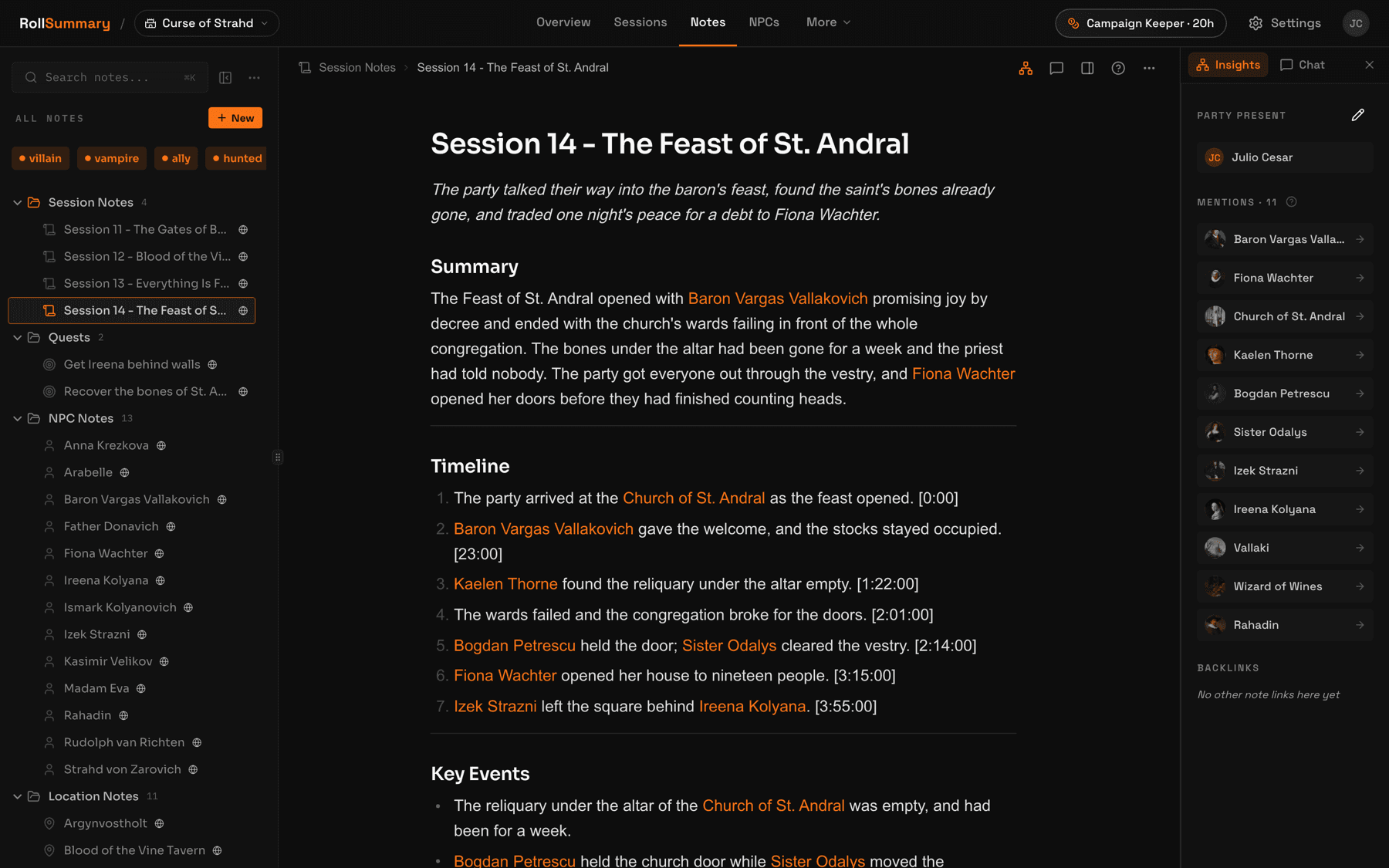
This is ours, so here is the specific version rather than the pitch. You upload the audio or video from the night you played. You get a timestamped transcript you can click into line by line, and a structured recap with a TL;DR, the key events in order, character beats, and the threads the party is about to pull. A four hour session takes about ten minutes.
Then it files itself: an NPC note per named person, a location note per place, a quest note per thread, all wiki-linked with backlinks and a local graph, so a tavern keeper's page lists every session he turned up in with nobody tagging anything. Nothing becomes canon until you approve it, note by note, and you can edit or reject any proposed change. Recaps and notes come back in the language your table actually speaks.
The free tier is one session, up to 90 minutes, with its recap and wiki, no card. Paid plans are $10 a month for 6 session hours, $25 for 20, and $49 for 40, with unlimited campaigns, notes, and players on every one of them. Export is an Obsidian vault zip with YAML frontmatter and wiki-links, available on every plan and to every role including players.
What we do not have: maps, stat blocks, invented calendars, whiteboards, manuscripts, offline editing, a Discord bot, or a Foundry integration. If any of those is the thing you are shopping for, one of the seven tools above is a better buy and we would rather you found that out here.
- Audio or video in, transcript, recap, and linked notes out
- Every proposed change reviewed by you before it becomes canon
- Obsidian vault export with frontmatter and wiki-links, on every plan
- Players read recaps and browse the wiki for free
The question to ask any tool that writes notes for you
Ask it what it does when your table says a player's name. This sounds like a detail and it is the single most common way an automatically built wiki turns to garbage. People at a table say the player's real name far more than the character's: somebody asks Renan to roll, not Thoradin, and the transcript is thick with it. A tool that files names without understanding the difference creates an NPC page for Renan, and now your friend sits in the bestiary next to the villain. There is a well-known thread title in the hobby about a tool that confuses players with characters, and it gets quoted every time the subject comes up.
RollSummary blocks it in four places. Binding a character to a player folds that player's name into the character note's alias list, so both names already resolve to one sheet. The planner is instructed that a party member is always a player character and never an NPC, and that a player's real name in the transcript means the character they play, so the facts land on the existing character note. The applier re-checks the type on the way in. The duplicate judge is told outright that a player character and an NPC are never the same entity, so nothing can merge them by accident either.
If a wiki was already polluted, the wiki health screen lists notes whose title or alias matches a player's name and offers that player's character note as the merge target. Merging folds the wrong title into the keeper's aliases, which permanently teaches the pipeline that the name belongs to the character. The hand-typed tools on this list never have this problem, because they never guess. That is precisely the trade you are making, and it is worth making deliberately.
Pick by the problem you actually have
Nine lines, one of which is probably yours. Read down until something stings.
- Your notes are fine and you just want to own the files forever: Obsidian, free.
- You want NPC and quest tables with properties and filters, and you already live in the tool: Notion.
- You want typed entries, invented calendars, and pinned maps without paying anything: Kanka.
- Your world is the hobby and you want to publish it to an audience: World Anvil.
- You want the best-feeling wiki and a serious atlas, and you never want a tool writing for you: LegendKeeper.
- Your table plays on D&D Beyond's maps and you want a quick jot during play: D&D Beyond journals.
- You play on Discord or Foundry and want the session captured there: Archivist.
- Your problem is that the notes never get written, and the only artifact of last session is a four hour recording: RollSummary.
- You cannot record your table, for consent or practical reasons: everything on this list except Archivist and RollSummary still works for you.
Two of these are worth running together. A hand-built world in Obsidian, Kanka, or LegendKeeper plus session notes generated from the recording covers both halves, and the markdown exports on both sides mean you can consolidate later without retyping anything.
All eight, side by side
Entry price means the cheapest way to use the tool seriously, which is sometimes free. Every figure was read from the vendor's own pricing page in September 2026.
| Tool | Entry price | Best for | Notes from a recording | Export |
|---|---|---|---|---|
| Obsidian | Free, Sync from $4/mo | Owning plain markdown files forever, offline | Nothing. You type every word | They are already your files |
| Notion | Free, Plus $10/member/mo | Relational NPC, quest, and faction tables | Nothing aimed at a game session | PDF, HTML, markdown, CSV |
| Kanka | Free, paid from $4.99/mo | Typed entries, invented calendars, pinned maps | Journals you write yourself | JSON or markdown, once a day |
| World Anvil | Free, paid from $7/mo | Publishing a world to an audience | Live note-taking, no recording | JSON and HTML zip, paid tiers |
| LegendKeeper | Free, Pro $9/mo | A fast wiki and a serious atlas | Nothing, by stated policy | Markdown, JSON, or .LK, all tiers |
| D&D Beyond journals | Free, Hero $2.99/mo | A quick jot during play on their maps | Manual notes, shared player editing | Not documented |
| Archivist | From $10/mo, 4 sessions | Discord and Foundry tables | Recaps and a wiki from the session | No file export listed |
| RollSummary | First session free, then $10/mo | Turning a recording into a reviewed wiki | Transcript, recap, and linked notes | Obsidian vault zip, every plan |
The two that work from a recording, priced properly
Six of the eight cost you time rather than money, and their prices are in the table above. The two that turn a session into notes are worth putting side by side, because they meter completely differently: Archivist counts sessions, RollSummary counts hours of audio.
Archivist
| Plan | Price | What you get |
|---|---|---|
| Trial | 30 days | No card required. 1 campaign, 2 sessions, 5 generated images. |
| Casual | $10 / mo | 1 campaign and 4 sessions a month. Extra sessions are $2 each, an extra campaign pass is $6. |
| Seasoned | $20 / mo | 3 campaigns and 10 sessions a month. |
| Pro | $35 / mo | 5 campaigns and 20 sessions a month. |
| Legend | $60 / mo | 10 campaigns and 40 sessions a month. |
RollSummary
| Plan | Price | What you get |
|---|---|---|
| Free | $0 | One free session, up to 90 minutes, comes back as a recap and a linked wiki. No card required. Campaigns, players, and notes stay unlimited and free. |
| Tavern Scribe | $10 / mo | $100 a year. 6 session hours a month, roughly one or two sessions, plus 5 GB of kept recordings. |
| Campaign Keeper | $25 / mo | $250 a year. 20 session hours a month, which covers a weekly four hour table, plus 25 GB. |
| Dungeon Master | $49 / mo | $490 a year. 40 session hours a month for two or three tables, plus 50 GB. |
Every price on this page was read in September 2026. Prices move, so check the source before you budget: D&D Beyond player editing update (September 2, 2026), obsidian.md/pricing, notion.com/pricing, kanka.io/pricing, worldanvil.com/pricing, legendkeeper.com/pricing, dndbeyond.com/en/subscribe, myarchivist.ai/pricing.
Questions GMs actually ask
Which of these can turn a session recording into notes?
Two of the eight: Archivist (myarchivist.ai) and RollSummary. Obsidian, Notion, Kanka, World Anvil, LegendKeeper, and D&D Beyond journals all require you to type, and none of them offers audio upload or transcription as of September 2026. LegendKeeper says so explicitly in its own FAQ, and it is a deliberate product decision rather than a missing feature.
What is the best free D&D note-taking app?
Obsidian if you want to own the files, because it is free for personal use with no account and no limits, and your notes are plain markdown on your own disk. Kanka if you want a structured campaign database, because its free tier gives unlimited entries and unlimited campaigns. LegendKeeper's free Basic tier is worth knowing about too, since it lets you view, export, and collaborate on projects other people own.
Can I use two of these together?
Yes, and it is the setup we would recommend to most GMs. Keep the world you build by hand wherever you enjoy building it, and let something else handle what happened at the table each week. Obsidian, LegendKeeper, and RollSummary all export markdown, so a single vault can eventually hold both halves, though Kanka's markdown export cannot be re-imported and World Anvil's content is BBCode rather than markdown.
Do my players need to pay for any of this?
Rarely. LegendKeeper's unlimited guests collaborate free and only the project owner subscribes. RollSummary works the same way: players join with an invite link, read recaps, browse the wiki, comment, and export the vault at no cost. Notion charges per member, so a shared workspace with five players on a paid plan is five seats.
How accurate is a recap generated from a recording?
Good enough to be worth editing, not good enough to publish unread, which is why RollSummary saves nothing until you approve it. Invented fantasy names are the usual failure, and correcting one once teaches the alias for every later session. Any tool in this category that does not show you a review step before writing to your wiki should be treated with suspicion.
What about consent to record the table?
Ask your players before you record anything, every time, and take no for an answer. It is their voices. RollSummary deletes the audio after processing unless you choose to keep it, does not train on your sessions, and keeps recaps and notes private to your campaign, but none of that substitutes for asking the people at the table first.
Which one should I pick if I only run a game once a month?
A monthly table is the case where the free tiers genuinely work. Obsidian or Kanka cost nothing and a once-a-month campaign will not outgrow either. If you would rather the notes wrote themselves, RollSummary's entry plan covers 6 session hours a month, which is one long session, and Archivist's entry plan covers 4 sessions, so at that cadence they cost about the same.
Keep reading
- RollSummary vs Kanka
The full head-to-head: typed entries, invented calendars, per-campaign pricing, and what neither of us does.
- RollSummary vs World Anvil
Templates, maps, BBCode, and why the structured export is a paid feature.
- RollSummary vs LegendKeeper
The fastest wiki on the list, its stated policy on generative features, and the three export formats.
- RollSummary pricing
Session hours, storage, and what the free first session actually includes.
Try it on your next session
If you got this far because your wiki is empty and the reason is time rather than tooling, record the next night you play and upload the file. The first session is free, there is no card, and every note waits for your approval before it becomes canon.
We don't train on your sessions. Audio is deleted after processing unless you choose to keep it.