LegendKeeper alternative
LegendKeeper alternative: the notes come from the session, not the keyboard
LegendKeeper is the best-feeling worldbuilding wiki in the hobby and it has decided, on purpose, never to generate anything for you. RollSummary is the opposite bet: record the session, and the recap and the linked notes arrive already written for you to approve.
Published by RollSummary. Meet Julio Cesar, the developer.
Most comparison pages pretend the other tool has a flaw where it actually has a philosophy. LegendKeeper's FAQ answers the question "Does LegendKeeper have generative AI features?" with a plain "No", and that is a considered position from a team that clearly cares about the craft of worldbuilding. Plenty of GMs want exactly that, and they should buy it.
So this page is not an argument that LegendKeeper is missing something. It is an argument about which half of the campaign-notes problem you actually have. If your problem is that your world lives in your head and you want a beautiful, fast place to build it out, LegendKeeper is genuinely excellent. If your problem is that the session ended at midnight, you remember three of the eleven names that came up, and the wiki has been empty since session four, then no amount of editor polish fixes it, because the bottleneck was never the typing speed.
Every LegendKeeper fact below was read from legendkeeper.com in September 2026 and is dated where a price is involved.
Who LegendKeeper is for
LegendKeeper is a wiki with infinite page nesting, auto-linking between pages, templates, slash commands, tags, properties, and full-text search. It feels fast in a way most worldbuilding tools do not, and the people who love it tend to talk about the feel first and the feature list second.
The atlas is the headline. Maps go up to 14,000 pixels and 100 MB, pins carry custom icons, colours and border styles, maps nest inside each other like pages do, and you can filter pins by tag. Fog of war is not there yet: it sits on the published Planned Features list alongside layers, region drawing, and pin grouping, which is worth knowing before you buy on the strength of a demo video.
Two more things make it distinctive. Real-time collaboration with visible cursors means a co-GM can be editing the same page as you, and offline editing means you can write on a train and have it sync when you reconnect. There are also collaborative whiteboards for flowcharts, GM screens, and pointcrawls, which is a genuinely different way of thinking about prep than a page tree.
Pricing is refreshingly simple. Basic is free forever and lets you view, export, and collaborate on projects. Pro is $9 a month, or $90 a year, which works out to $7.50 a month, and covers unlimited projects, pages, maps, timelines, whiteboards, storage, and collaborators. The trial is 14 days with no credit card, and unlimited guests participate free: only the project owner needs a subscription.
What LegendKeeper does better than us
The atlas, without argument. A 14,000 pixel map with tagged, filterable, custom-styled pins is a category of feature RollSummary simply does not have, and if that is how you run your game the rest of this page is academic.
Real-time co-editing. Two people in the same page with visible cursors is a better co-GM experience than ours, where two people editing the same note is something you coordinate socially rather than something the tool solves.
Offline. LegendKeeper lets you edit the wiki and atlas offline and syncs when you reconnect. RollSummary needs a connection, and the parts of it that matter most need a server anyway, since transcription does not happen on your laptop.
Whiteboards. Flowcharts, pointcrawls, and a drag-around canvas for the shape of an adventure have no equivalent on our side. Our structure is a note tree, links, and a graph, which is a different and narrower idea.
Price, again. $9 a month against our $10 is close, but their $90 a year against our $100 for the entry tier, with unlimited everything on their side and 6 session hours on ours, is not a comparison we win on paper. What we sell per hour is machine time on your audio, and that has a floor.
What RollSummary does that LegendKeeper does not
Nothing in LegendKeeper reads your session. There is no audio upload, no transcription, and no automatic page creation, and the roadmap's only audio item is embedding rich media, which is a player for files rather than a listener for them. Every page in a LegendKeeper wiki exists because a human sat down and wrote it.
RollSummary's starting point is the recording. Upload the audio or video from the night you played, and you get back a timestamped transcript you can click into, a structured recap with a TL;DR, the key events in order, character beats, and the threads the party is about to pull. A four hour session comes back in roughly ten minutes.
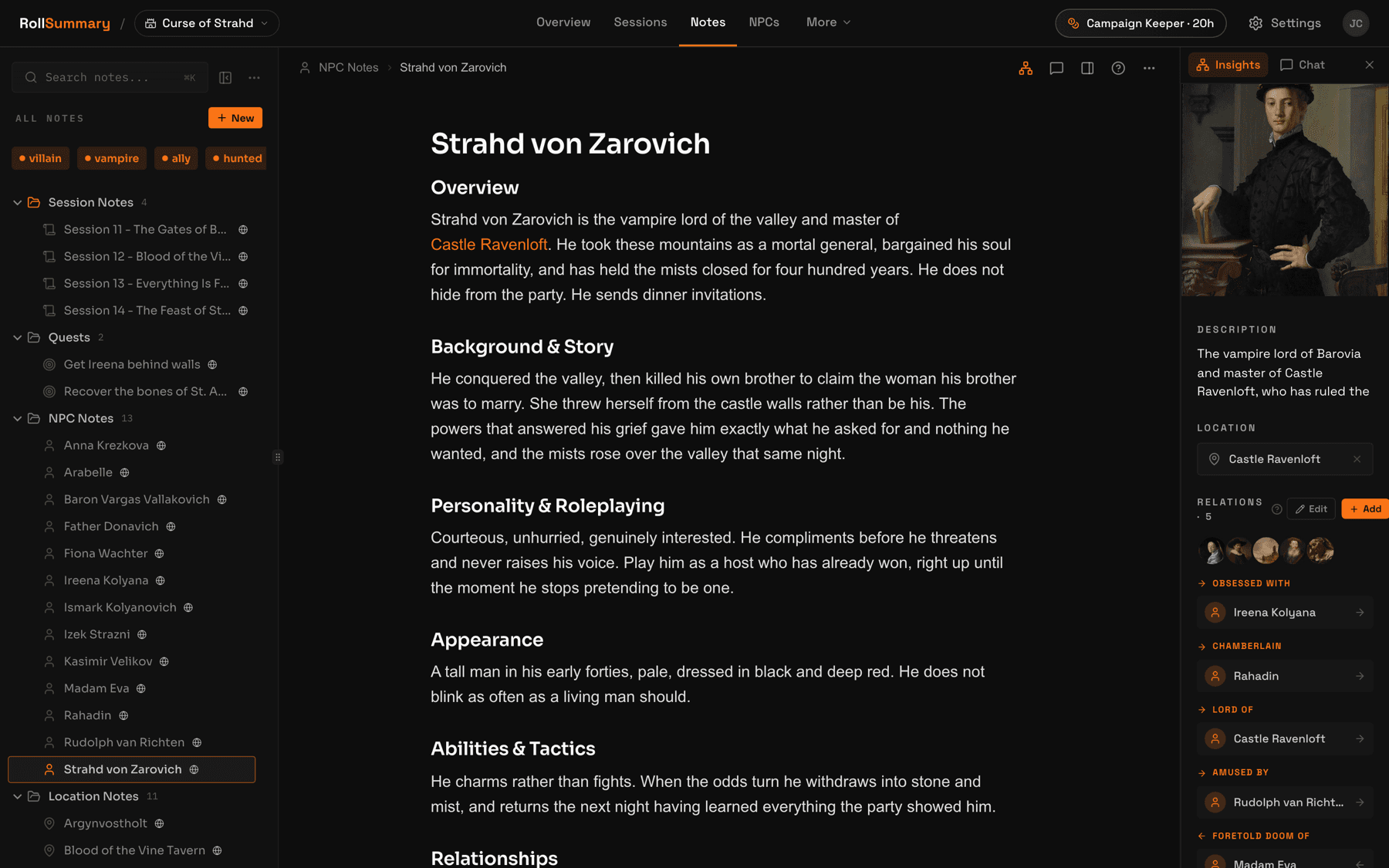
Then it files itself. Every named person becomes an NPC note, every place a location note, every thread a quest note, wiki-linked to each other with backlinks and a local graph, so the innkeeper's page lists every session he turned up in without anyone tagging anything. The structure that LegendKeeper gives you the tools to build, RollSummary tries to build for you from what was actually said.
Every one of those changes waits for you. A run produces a reviewable set of proposals: accept, edit, or reject, note by note, before anything becomes canon. If the transcript misheard a name, you fix it once and the alias sticks.
And you can ask the wiki things. Campaign chat reads every note plus any campaign PDF or sourcebook you have uploaded, answers in plain language, and links the notes it used so you can check before you say it at the table.
- Audio or video in, transcript, recap, and linked notes out
- Notes created from what was said, not from what you remembered to type
- Review every proposed change before it becomes canon
- Chat across the whole wiki and your uploaded books, with citations
Both of us let you leave
LegendKeeper is unusually honest about this and deserves credit for it. Its pricing page commits to keeping an export feature so you can leave at any time regardless of subscription status, and export works on the free Basic tier. You can take a single markdown file, a zip of markdown files suitable as an Obsidian vault, a human-readable JSON export, or a compressed .LK file for sharing pages, maps, and boards.
The markdown export is explicitly partial: their own changelog notes it does not include maps, boards, properties, or some editor content block types. The JSON and .LK exports are complete except for permissions. So the fully faithful copy of your world is JSON, and the portable copy is markdown with holes in it.
RollSummary exports one zip: a markdown file per note in folders for Sessions, Quests, NPCs, Locations, PCs and Notes, with YAML frontmatter carrying aliases and tags, and wiki-links preserved so the folder opens as an Obsidian vault with the graph intact. It is available on every plan and to every role, including free accounts and including players. We have less to export than LegendKeeper does, because we have no maps or boards to lose in translation.
Your player is not an NPC
This is the failure mode that makes GMs distrust any tool that writes notes for them, and they are right to. Tables say the player's real name far more than the character's: someone asks Renan to roll, not Thoradin. A pipeline that files names blindly creates an NPC page for Renan, and now your bestiary has your friend in it. There is a well-known thread title in the hobby about a tool that confuses players with characters, and it is quoted every time this subject comes up.
RollSummary treats the people at the table as people at the table, in four places. Binding a character to a player folds that player's name into the character note's alias list, so the two names already point at one sheet. The planner is instructed that a party member is always a player character and never an NPC, and that a player's real name in the transcript means the character they play, so the facts go onto the existing character note. The applier re-checks it on the way in. The duplicate judge is told outright that a player character and an NPC are never the same entity, so a merge cannot quietly do the damage either.
If a wiki was already polluted, the wiki health screen lists notes whose title or alias matches a player's name and offers that player's character note as the merge target. Merging folds the wrong title into the keeper's aliases, which permanently teaches the pipeline that the name belongs to the character. LegendKeeper never has this bug, of course, because LegendKeeper never guesses at anything. That is the trade, stated plainly.
Pick LegendKeeper if
There is a large and reasonable set of GMs for whom LegendKeeper is the right purchase and we are not. Here it is.
- You want a tool that never generates text, on principle. LegendKeeper says so publicly and has stuck to it.
- Your campaign is map-led and you need a real atlas with big images, styled pins, and tag filtering.
- You and a co-GM prep together and want real-time cursors in the same page.
- You write offline, on trains and planes, and need the wiki to sync afterwards.
- Whiteboards, flowcharts, and pointcrawls are how you think about an adventure.
- You do not record your sessions. Almost everything RollSummary does begins with a recording.
- You want unlimited pages and storage for a flat $9 a month rather than a monthly hour allowance.
If your honest answer to "why is my wiki empty?" is "I never got around to it" rather than "the editor is slow", that is the one case where we are the better buy. Otherwise, LegendKeeper is a lovely piece of software and you should go and use it.
Side by side
LegendKeeper facts came from its own homepage, features page, pricing page, FAQ, and changelog in September 2026.
| What you are comparing | LegendKeeper | RollSummary |
|---|---|---|
| Where the notes come from | You write every page. No generative features, by design | The session recording becomes the recap and the linked notes |
| Session audio | No upload or transcription. Audio embedding is a planned feature | Upload audio or video, get a timestamped transcript you can click into |
| Maps | Atlas with 14K pixel maps, styled pins, nesting, and tag filters | None. Locations are notes with links, backlinks, and a graph |
| Collaboration | Real-time co-editing with visible cursors | Player and co-GM roles, per-note visibility, a shared party feed |
| Offline | Edit offline, sync on reconnect | Online only. Transcription runs on our servers, not your laptop |
| Canvas and boards | Collaborative whiteboards, flowcharts, GM screens, pointcrawls | Note tree, wiki-links, backlinks, and a local graph |
| Asking the wiki a question | Full-text search | Chat across every note and your uploaded PDFs, with citations |
| Export | Markdown (partial), JSON, or .LK, free on every tier | Obsidian vault zip with frontmatter and wiki-links, every plan, every role |
| Entry price | $9 a month, or $90 a year, unlimited everything | $10 a month, or $100 a year, 6 session hours a month |
What each one costs
LegendKeeper sells a flat seat with unlimited content. RollSummary sells session hours, because the cost of turning a recording into notes scales with how long your table played.
LegendKeeper
| Plan | Price | What you get |
|---|---|---|
| Basic | Free | View and export all your projects, and collaborate on projects other people own. |
| Pro | $9 / mo | $90 a year, which is $7.50 a month. Unlimited projects, pages, maps, timelines, whiteboards, storage, and collaborators, plus publish to web. |
| Trial | 14 days | No credit card required. Unlimited guests collaborate free; only the project owner needs a subscription. |
RollSummary
| Plan | Price | What you get |
|---|---|---|
| Free | $0 | One free session, up to 90 minutes, comes back as a recap and a linked wiki. No card required. Campaigns, players, and notes stay unlimited and free. |
| Tavern Scribe | $10 / mo | $100 a year. 6 session hours a month, roughly one or two sessions, plus 5 GB of kept recordings. |
| Campaign Keeper | $25 / mo | $250 a year. 20 session hours a month, which covers a weekly four hour table, plus 25 GB. |
| Dungeon Master | $49 / mo | $490 a year. 40 session hours a month for two or three tables, plus 50 GB. |
LegendKeeper prices read from legendkeeper.com in September 2026. Prices move, so check the source before you budget: legendkeeper.com/pricing, legendkeeper.com/features, LegendKeeper FAQ.
Questions GMs actually ask
Does LegendKeeper transcribe or summarize sessions?
No, and it is deliberate. Its own FAQ answers the question about generative features with a flat no, and the only audio item anywhere on its roadmap is embedding rich media, which plays a file rather than listening to one. If you want a tool that never writes anything on your behalf, that is a feature and LegendKeeper is the pick.
Can I use both?
Yes, and the export formats make it workable. LegendKeeper exports a zip of markdown files intended to open as an Obsidian vault, and RollSummary exports the same shape, so a single vault can hold your hand-built world and your recorded sessions side by side. Be aware that LegendKeeper's markdown export leaves out maps, boards, and properties, so keep a JSON export as the faithful copy.
Is RollSummary cheaper?
No. LegendKeeper Pro is $9 a month with unlimited pages, maps, and storage. Our entry plan is $10 a month with 6 session hours, and hours are the thing that actually costs us money for every recording we process. On raw price per page stored, they win, and we would rather say so here than have you find out at checkout.
Do my players need to pay for RollSummary?
No. Players join with an invite link and read recaps, browse the wiki, comment, vote in the recap poll, and export the vault for free. Only the account uploading recordings needs a paid plan, which is normally the GM. LegendKeeper works the same way: unlimited guests are free and only the project owner subscribes.
What happens to my notes if I stop paying?
Nothing disappears. Campaigns, recaps, notes, and the wiki stay readable, editable, and exportable. New transcription and new generated notes stop until you subscribe again, and everything already written stays yours.
Does RollSummary have maps or whiteboards?
Neither. Locations are notes with images, links, backlinks, and a local graph, which answers who lives where and what happened there, but there is no atlas with pins and no canvas to draw a pointcrawl on. If your prep is map-first or diagram-first, LegendKeeper is the better tool and it is not close.
How accurate is a generated recap?
Good enough to be worth editing, not good enough to trust unread, which is why nothing is saved until you approve it. Transcription mishears invented fantasy names in particular, so the first time a name comes through wrong you correct it and the alias sticks for every session afterwards. The review step is the product, not a disclaimer.
Keep reading
- RollSummary vs Kanka
The generous free worldbuilding database with around twenty typed entry kinds, custom calendars, and per-campaign pricing.
- RollSummary vs World Anvil
Article templates, interactive maps, novel-writing tools, and a very large publishing community.
- The best D&D note-taking apps in 2026
Obsidian, Notion, Kanka, World Anvil, LegendKeeper, D&D Beyond journals, Archivist, and us, compared honestly.
- RollSummary pricing
Session hours, storage, and what the free first session actually includes.
Try it on your next session
Record the next night you play and upload the file. The first session is free, no card, and the recap and notes wait for your approval before they touch anything. If it does not earn its place next to your LegendKeeper atlas, you will know inside one session.
We don't train on your sessions. Audio is deleted after processing unless you choose to keep it.