Kanka alternative
Kanka alternative: the wiki writes itself from the session you recorded
Kanka is a worldbuilding database you fill in by hand, and it is a very good one. RollSummary starts at the other end: you record the night you played, and the recap and the linked notes come back written.
Published by RollSummary. Meet Julio Cesar, the developer.
Two tools can both be called a campaign wiki and still be aimed at completely different Tuesdays. Kanka is built for the GM who prepares: you sit down before the session, create a character, create the city they live in, connect the two, hang a quest off it, and place a pin on the map. RollSummary is built for the GM who never gets around to that, because the session ran until midnight and the only artifact of it is a four hour recording nobody wants to listen to again.
This page is written by the people who make RollSummary, so treat the enthusiasm accordingly. What we can promise is that every Kanka fact below came from Kanka's own pricing, features, and documentation pages in September 2026, and that where Kanka is simply better we say so instead of burying it in a checkmark grid.
If you already run a Kanka campaign and love it, the honest answer is usually not "switch". It is that the two tools solve different halves of the same problem, and the half Kanka does not touch is the one that eats your Monday night.
Who Kanka is for
Kanka is a structured worldbuilding database with around twenty typed entry kinds: characters, locations, families, organisations, items, quests, journals, calendars, events, abilities, timelines, religions, and tags. The typing is the point. A character is not a page that happens to describe a person, it is a character record with fields, and everything you attach to it inherits that structure.
It is generous with the free tier in a way that is genuinely rare. A free Kobold account gets unlimited entries and unlimited campaigns, and premium is bought per campaign rather than per account, so the campaign you are actively running can be upgraded while the four half-finished ones you abandoned stay free. The homepage claims over 400,000 game masters and worldbuilders on the platform, which shows in how much community material exists for it.
The maps and the calendars are the features people stay for. You upload a map, add layers, drop pins, and control visibility per pin, so the players see the three towns they have visited and not the lich's tower. The calendar system handles custom years, months, weeks, seasons and moons, with more than one calendar per campaign, and timelines split into eras so a country's history and a character's arc can sit on different scales.
What Kanka does better than us
Maps. RollSummary has none. If your table plays on a hand-drawn continent and half your prep is placing pins on it, Kanka wins that outright and nothing on our roadmap changes it this year.
In-world time. Kanka's custom calendars and era timelines let you say the coronation happened in the third month of the seventh year of the current dynasty and have the tool understand it. RollSummary tracks the real dates your sessions happened and orders them, which is a much smaller idea.
Permission granularity. Kanka gives a campaign roles, per-entry and per-pin visibility, and a preview mode that shows you the campaign exactly as a specific member sees it. That preview is a genuinely good idea and we do not have an equivalent: our visibility model is per note (private, shared with the party, or public) with player and co-GM roles, which covers the common case and not much more.
Price, at the bottom of the ladder. Kanka's cheapest paid tier is $4.99 a month, and that buys a campaign more storage and members. Our cheapest paid plan is $10 a month, because every hour of audio we process costs real money on the way through. We are not the budget option and pretending otherwise would be insulting.
What RollSummary does that Kanka does not
Kanka's journals are free-form text: its own documentation describes them as the place for session prep, session recap, and props, written by you. That is the entire session-notes story. There is no audio upload, no transcription, and nothing that reads a session and files what happened. We checked the features page and the docs, and the gap is real, not an oversight in our reading.
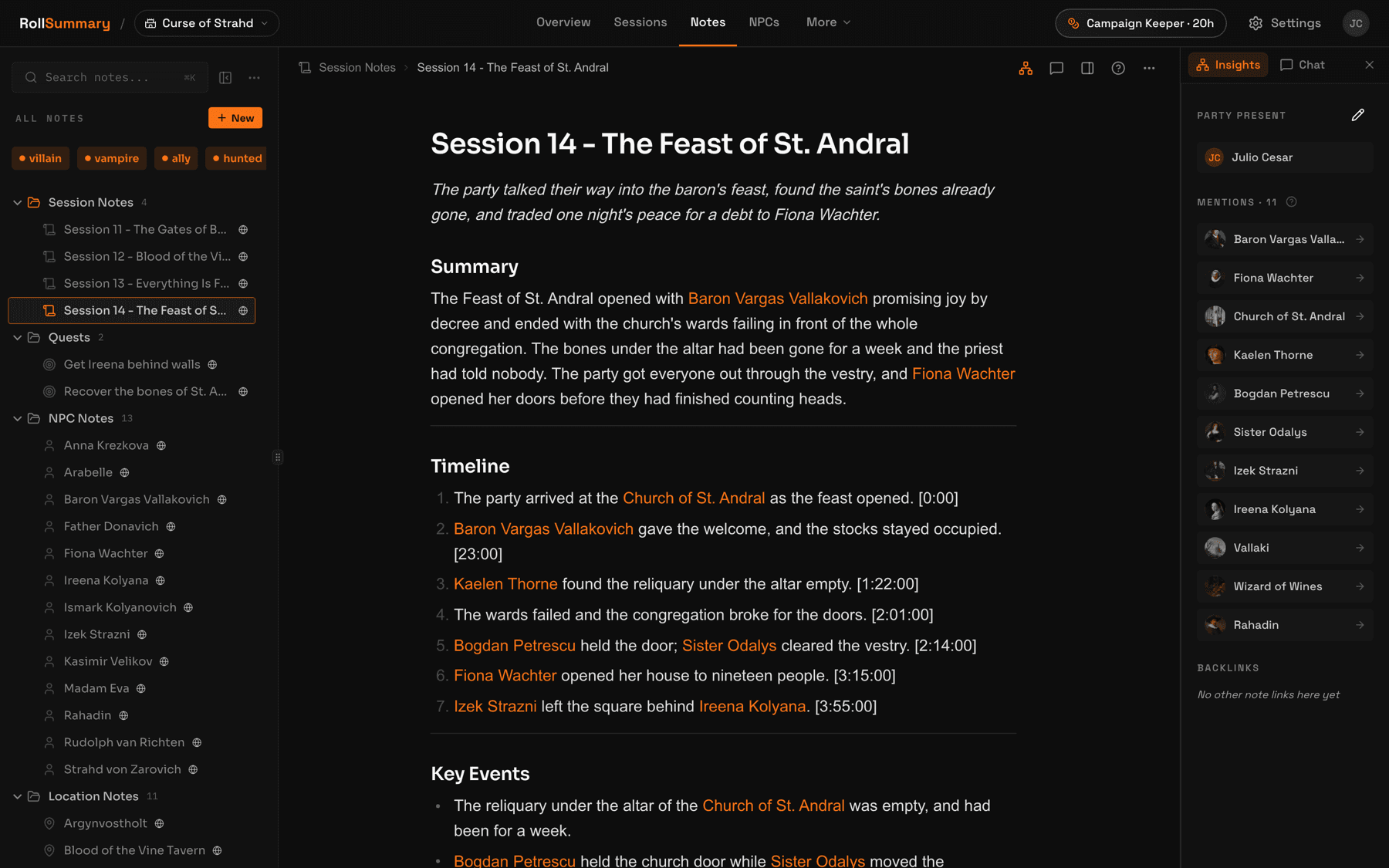
RollSummary's whole product is that gap. You upload the recording, you get a transcript, and then a structured recap: a TL;DR, the key events in order, character beats, and what the party is about to chase. A four hour session comes back in about ten minutes. The notes come with it: an NPC note for every named person, a location note for every place, a quest note for every thread, each one wiki-linked to the others, with backlinks and a local graph so the innkeeper's page lists every session he has appeared in without you tagging anything.
Nothing lands as canon behind your back. Every run produces a set of proposed changes you review, edit, or reject before they touch the wiki. That review step is the product, not a disclaimer bolted onto it.
Once the wiki exists you can talk to it. Campaign chat reads every note, plus any sourcebook or campaign PDF you have uploaded, and answers with links to the notes it used, so you can check the sources before you say something out loud at the table.
- Recording in, transcript, recap, and linked notes out, in about ten minutes for a four hour session
- Six note types (session, NPC, location, PC, quest, and plain note) plus your own folders, tags, and aliases
- Wiki-links, backlinks, and a local graph, all generated from what was actually said
- You approve every proposed change before it becomes canon
Getting your world back out
Both tools take this seriously, which is worth saying out loud in a hobby full of walled gardens. Kanka exports a campaign as JSON, which includes entry images and can be imported back into Kanka, or as markdown, which is readable but cannot be re-imported. Exports run once a day and the resulting ZIP is downloadable for 120 minutes before it is deleted.
RollSummary exports the campaign as an Obsidian vault: one markdown file per note, sorted into Sessions, Quests, NPCs, Locations, PCs and Notes, with YAML frontmatter carrying aliases and tags, and the wiki-links preserved so the vault opens with its graph intact. It is available on every plan and to every role, including the free one and including players, because a note you cannot take with you is not really yours.
Neither tool imports the other's files today. If you are running both, the realistic pattern is Kanka for the map and the calendar, RollSummary for what happened at the table, and a markdown export from whichever one you eventually consolidate into.
Your player is not an NPC
Tables say the player's real name far more often than the character's. Someone asks Renan to roll, not Thoradin, and the transcript is full of it. A tool that files names into a wiki without knowing the difference will happily create an NPC page for Renan, sitting in your bestiary next to the actual villain. GMs have been complaining about exactly this failure in public threads, and it is the fastest way to make an auto-built wiki useless.
RollSummary treats the people at the table as people at the table. When a character is bound to a player slot, that player's name is folded into the character note's alias list, so the pipeline already knows the two names point at the same sheet. The planner is told explicitly that a party member is always a player character and never an NPC, and that a player's real name in the transcript refers to the character they play, so those facts go on the existing character note rather than minting a new one. The applier catches it again on the way in, and a semantic duplicate check refuses to ever merge a player character into an NPC.
For wikis that were already damaged, the wiki health screen lists notes whose title or alias matches a player's name and offers the right character note as the merge target. Merging folds the wrong title into the keeper's aliases, which is what permanently teaches the pipeline that the name belongs to the character. Kanka never has this problem, because Kanka never guesses, but that is the same reason it never writes anything for you either.
Pick Kanka if
There is a real set of GMs for whom Kanka is the correct answer and we are not. Here is that set, written plainly.
- Maps are the spine of your campaign and you need layers, pins, and per-pin visibility.
- Your world runs on an invented calendar and you want the tool to understand months, moons, and eras rather than just real-world session dates.
- You genuinely enjoy the act of worldbuilding in a database, and prep is the fun part rather than the chore.
- You need fine-grained permissions and the ability to preview the campaign through a specific member's eyes.
- You are running many campaigns at once and want to pay for premium on only the active one.
- Budget is the deciding factor: $4.99 a month against our $10 is a real difference, and nothing we do makes that gap disappear.
- You do not record your sessions and have no intention of starting. Almost everything we do begins with a recording.
If two or more of those are true, use Kanka. If none of them are, and the reason your wiki is empty is that you never had an hour spare to fill it in, that is the case we built for.
Side by side
Read the middle column as a compliment where it deserves one. Kanka facts were taken from Kanka's own pricing, features, and documentation pages in September 2026.
| What you are comparing | Kanka | RollSummary |
|---|---|---|
| Where the notes come from | You type every entry by hand, including session journals | The session recording becomes the recap and the linked notes |
| Session audio | No upload, no transcription, journals are free-form text | Upload audio or video, get a timestamped transcript you can click into |
| Maps | Layered maps with pins and per-pin visibility | None. Locations are notes with links and backlinks |
| Calendars and timelines | Custom calendars with seasons and moons, timelines split into eras | Real session dates in order, no invented calendar |
| Entry structure | Around twenty typed entry kinds with their own fields | Six note types plus your own folders, tags, and aliases |
| Players | Members with roles, plus a preview of what each member sees | Players join free, read recaps, and never become wiki pages |
| Asking the wiki a question | Search and filters across entries | Chat that reads every note and your uploaded PDFs, and cites what it read |
| Export | JSON (re-importable) or markdown, once a day, ZIP live for 120 minutes | Obsidian vault zip with frontmatter and wiki-links, every plan, every role |
| Cheapest paid plan | $4.99 a month, per campaign | $10 a month, per account, all your campaigns |
What each one costs
Kanka charges per campaign for storage, members, and comfort. RollSummary charges per account for session hours, because the cost of turning a recording into notes scales with how long you played, not with how many campaigns you keep.
Kanka
| Plan | Price | What you get |
|---|---|---|
| Kobold | Free | Unlimited entries and campaigns. A standard campaign is capped at 10 members, 3 roles, and 150 MiB of gallery storage. |
| Owlbear | $4.99 / mo | $4.16 a month billed yearly. Per campaign, not per account. |
| Wyvern | $9.99 / mo | $8.33 a month billed yearly. Marked as the best value tier. |
| Elemental | $24.99 / mo | $20.82 a month billed yearly. Top tier limits. |
RollSummary
| Plan | Price | What you get |
|---|---|---|
| Free | $0 | One free session, up to 90 minutes, comes back as a recap and a linked wiki. No card required. Campaigns, players, and notes stay unlimited and free. |
| Tavern Scribe | $10 / mo | $100 a year. 6 session hours a month, roughly one or two sessions, plus 5 GB of kept recordings. |
| Campaign Keeper | $25 / mo | $250 a year. 20 session hours a month, which covers a weekly four hour table, plus 25 GB. |
| Dungeon Master | $49 / mo | $490 a year. 40 session hours a month for two or three tables, plus 50 GB. |
Kanka prices read from kanka.io in September 2026. Prices move, so check the source before you budget: kanka.io/pricing, kanka.io/features, Kanka export docs.
Questions GMs actually ask
Can I use Kanka and RollSummary together?
Yes, and plenty of people should. Keep the map, the calendar, and the pinned geography in Kanka, and let RollSummary handle what happened at the table. Neither tool imports the other's files today, so the bridge is markdown: RollSummary exports an Obsidian vault, Kanka exports markdown or JSON, and you consolidate by hand if and when you decide to.
Does Kanka transcribe or summarize sessions?
No. Kanka's journals are free-form text that you write, described in its own documentation as the place for session prep, session recaps, and props. There is no audio upload, no transcription, and no automatic note creation anywhere in its features or docs as of September 2026.
Is RollSummary cheaper than Kanka?
No. Kanka's paid tiers start at $4.99 a month per campaign and ours start at $10 a month per account. Transcription and note-writing cost money for every hour of audio we process, so our plans are sold in session hours: 6, 20, or 40 a month. If price is the deciding factor, Kanka wins that comparison and we would rather you knew before signing up.
Do my players have to pay?
No. Players join your campaign with an invite link, read recaps, browse the wiki, comment, and export the vault, all free. Only the account uploading recordings needs a paid plan, which is usually the GM.
What happens to my notes if I stop paying?
Nothing disappears. Your campaigns, recaps, notes, and wiki stay readable, editable, and exportable. You stop getting new transcription and new generated notes until you subscribe again, and everything already written stays yours.
Does RollSummary have maps?
No, and it is the most common thing people ask for. Locations are notes with links, backlinks, images, and a local graph, which is enough to answer who lives where and what happened there, but it is not a map with pins on it. If your prep is map-first, Kanka is the better tool.
How do I get my campaign out of RollSummary?
One zip, on every plan and every role. It contains a markdown file per note in folders for Sessions, Quests, NPCs, Locations, PCs, and Notes, with YAML frontmatter carrying aliases and tags, and wiki-links intact so the folder opens as an Obsidian vault with its graph already built.
Keep reading
- RollSummary vs World Anvil
The other big worldbuilding platform, with article templates, interactive maps, and a large publishing community.
- RollSummary vs LegendKeeper
A fast, polished, deliberately non-generative wiki with huge maps and real-time collaboration.
- The best D&D note-taking apps in 2026
Obsidian, Notion, Kanka, World Anvil, LegendKeeper, D&D Beyond journals, Archivist, and us, compared honestly.
- RollSummary pricing
Session hours, storage, and what the free first session actually includes.
Try it on your next session
Record the next night you play, upload the file, and see what comes back. The first session is free, no card, and if the recap is wrong you can edit it or throw it away before it becomes part of your wiki. Keep Kanka for the map.
We don't train on your sessions. Audio is deleted after processing unless you choose to keep it.